Key takeaways:
Merchandise financial planning (MFP) is often viewed as a process owned solely by the merchandising team, but this perspective misses the bigger picture. MFP ideally serves as the operational translation layer between your enterprise finance strategy and retail execution. The future of retail planning lies in bridging the gap between these two worlds.
Traditional organizations often treat financial planning and analysis (FP&A), MFP, supply chain planning, store planning, and payroll as sequential, disconnected processes. Finance plans at a highly aggregated level while merchandise planning plans at a granular, product-specific one. The result? A constant struggle to unite revenue, margin, and inventory goals.
In reality, these functions are deeply interdependent. An integrated planning approach recognizes this, aligning high-level financial objectives and the operational realities of retail.
5 key connection points
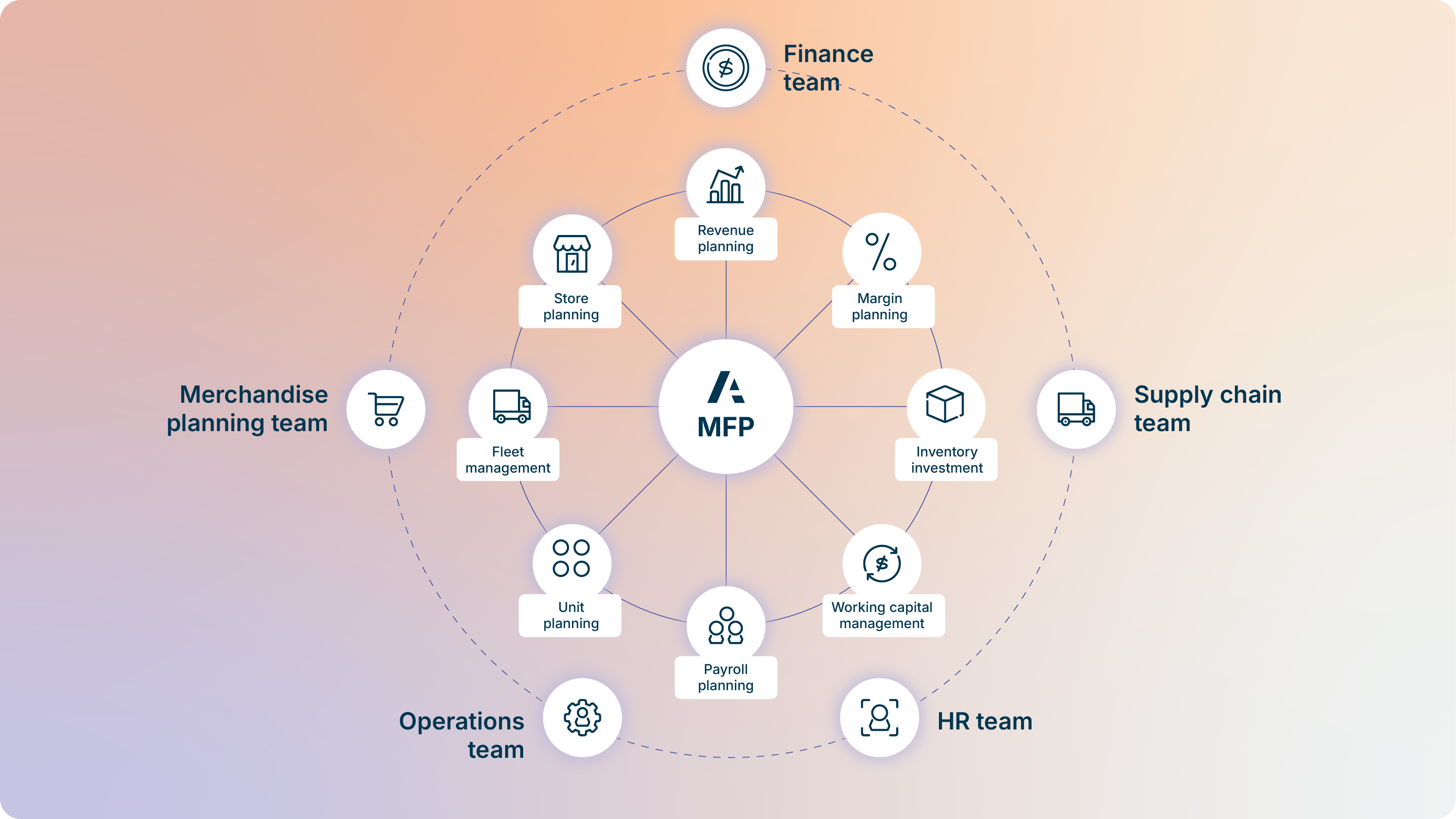
Synchronizing your financial strategy with your operational retail execution starts by focusing on the major intersections between your finance and planning teams:
1. Revenue planning alignment
Your finance team establishes top-line revenue targets for the company, channel, or region. Your merchandise planning team then has the critical task of translating those targets into detailed category, product, and seasonal assortment plans. This relationship must be bidirectional.
Finance may say, “We need 8% growth.” But what if assortment limitations, inventory restrictions, or pricing pressures make that target unrealistic? In a disconnected model, planning teams are forced to comply with potentially untenable financial guardrails.
With an integrated planning model, you can foster a consensus-based approach. You can model scenarios in real time to understand the operational impact of financial targets, enabling you to create financially constrained assortment plans that are validated by operational reality.
2. Margin planning alignment
Finance starts with operating income targets and derives the gross margin requirements needed to meet them. However, gross margin isn’t just a financial output — it’s the result of dozens of merchandise planning decisions. Your assortment architecture, pricing strategy, promotional cadence, and sourcing mix all directly determine your margin.
A connected model gives you unprecedented visibility. Your finance team can immediately understand the margin impact of a new promotional campaign or shifts in sourcing costs. Simultaneously, your merchandise planning team can see the operating profit and EBITDA sensitivity of their assortment decisions. This is where an integrated modeling architecture becomes uniquely powerful compared to siloed planning systems.
3. Working capital and inventory investment
From a financial perspective, inventory is working capital tied up on the balance sheet. For merchandise planning, inventory is product availability and the key to a great customer experience. These two perspectives can create tension. Finance may push to improve inventory turns, but achieving that goal requires operational trade-offs in assortment breadth, safety stock, and replenishment strategies.
This is where MFP and supply chain planning converge with FP&A. By integrating these functions, you can align on inventory strategies that optimize working capital while ensuring you have the right products in the right place to meet customer demand and drive sales.
4. Store planning and fleet productivity
In many retail organizations, store planning, real estate finance, and merchandise planning all build separate assumptions about store productivity. This fragmented approach is a massive missed opportunity.
Integrated planning enables shared assumptions and synchronized fleet plans. You can coordinate the financial impacts of store openings and closures, forecast the productivity uplift from remodels, and develop localized assortments based on a single, unified plan. This is especially valuable for omnichannel retailers with diverse store formats and seasonal product lines.
5. Payroll through unit and flow planning
Unit planning doesn’t just dictate inventory levels. It directly drives your labor requirements — from distribution center throughput and receiving labor to store replenishment and fulfillment staffing. When payroll planning remains isolated from merchandise receipt planning, the result is operational friction. Retailers risk understaffing during peak flow periods, overloading their DCs, utilizing labor inefficiently, and ultimately delivering a poor customer experience. Closing this gap presents a massive opportunity to integrate labor and workforce planning with operational finance.
This expands the integrated planning story well beyond finance and merchandise planning, bringing HR, store operations, and supply chain execution into the fold. While traditional integrated business planning (IBP) works well for manufacturing by uniting demand, supply, inventory, and finance, retail requires an additional, planning-centric layer to handle assortment, lifecycle planning, localized demand, and pricing strategies. In this complex environment, MFP acts as the essential connective tissue linking strategic finance, customer demand, inventory investment, and on-the-ground operational execution.
The future of retail is integrated
Integrated planning isn’t simply about aligning planning systems. It’s about synchronizing your financial strategy with your operational decision-making across the entire retail enterprise. By breaking down the silos between finance, merchandising, supply chain, store operations, and HR, you can build a more resilient, agile, and profitable retail business.