Key takeaways:
Retailers have become experts at planning the right products for the right stores. Yet sizing remains one of the last major planning decisions to rely on generic curves, historical averages, and judgment.
As customer demand becomes more local, more dynamic, and more difficult to predict, that approach increasingly leads to stockouts, markdowns, and missed revenue.
When a customer can’t find their size, the brand pays not only in a lost sale but in damaged loyalty. According to The State of Fashion 2025 by the Business of Fashion and McKinsey, out-of-stock sizes are shoppers’ number one complaint, while inaccurate stock purchasing across sizes can reduce monthly profits by up to 20%.
Has your sizing strategy been left to instinct and averages? If so, the financial and reputational impact may be greater than you think.
Anaplan’s Size Optimization application is designed to solve exactly this challenge. But first, it’s worth understanding why retail sizing has become so much harder than it used to be.
Why don’t generic retail size curves work?
Size curves are not stable inputs. They shift with local market preferences, demographic change, and fashion trends. The size curve built from last year’s buy ratios may already be out of date before the next season begins.
The challenge extends beyond changing demand. Size demand also varies between locations and products.
A size profile that works well in Minneapolis, for example, may be completely wrong in Miami, while different fabrics, fits, and garment types all influence what customers buy. Generic size curves simply aren’t designed to capture that level of variation.
New products make this harder still because planners have no sales history to guide initial size decisions. At the same time, population-level body size shifts are driven by factors ranging from generational change to the growing impact of GLP-1 medication, meaning yesterday’s size profile may no longer reflect today’s customer demand.
Why do stockouts create long-term planning problems?
Getting sizing wrong creates immediate financial penalties through stockouts, excess inventory, markdowns, and margin erosion. But the longer-term impact is easier to overlook. Retailers relying on historical sizing data that reflects only what was available to buy are making future decisions using an increasingly distorted picture of customer demand.
According to IHL Group’s 2025 Fixing Inventory Distortion report, retail out-of-stocks alone cost the global industry $1.2 trillion annually, with inventory distortion — including size-level misalignment — representing a major commercial challenge.
The problem isn’t simply that retailers run out of stock. Once a popular size sells out, the missing demand disappears from the historical record. Future size recommendations are then built on incomplete data unless that hidden demand is accounted for.
What should retailers look for in a size optimization solution?
These challenges expose the limitations of generic size curves and spreadsheet-based planning. Retailers need a solution designed to address the complexity of retail sizing:
- Large assortments that require repeatable precision across thousands of SKUs
- Sparse historical transaction data that makes pattern identification challenging
- Zero data that risks conflating low demand and stockouts
- Demand patterns that vary widely by region — or even location
- A need to predict newness without reliable comps
- Demand insight and planning workflows sitting in separate systems
This is exactly why Anaplan built the Size Optimization application.
How does Anaplan’s Size Optimization application work?
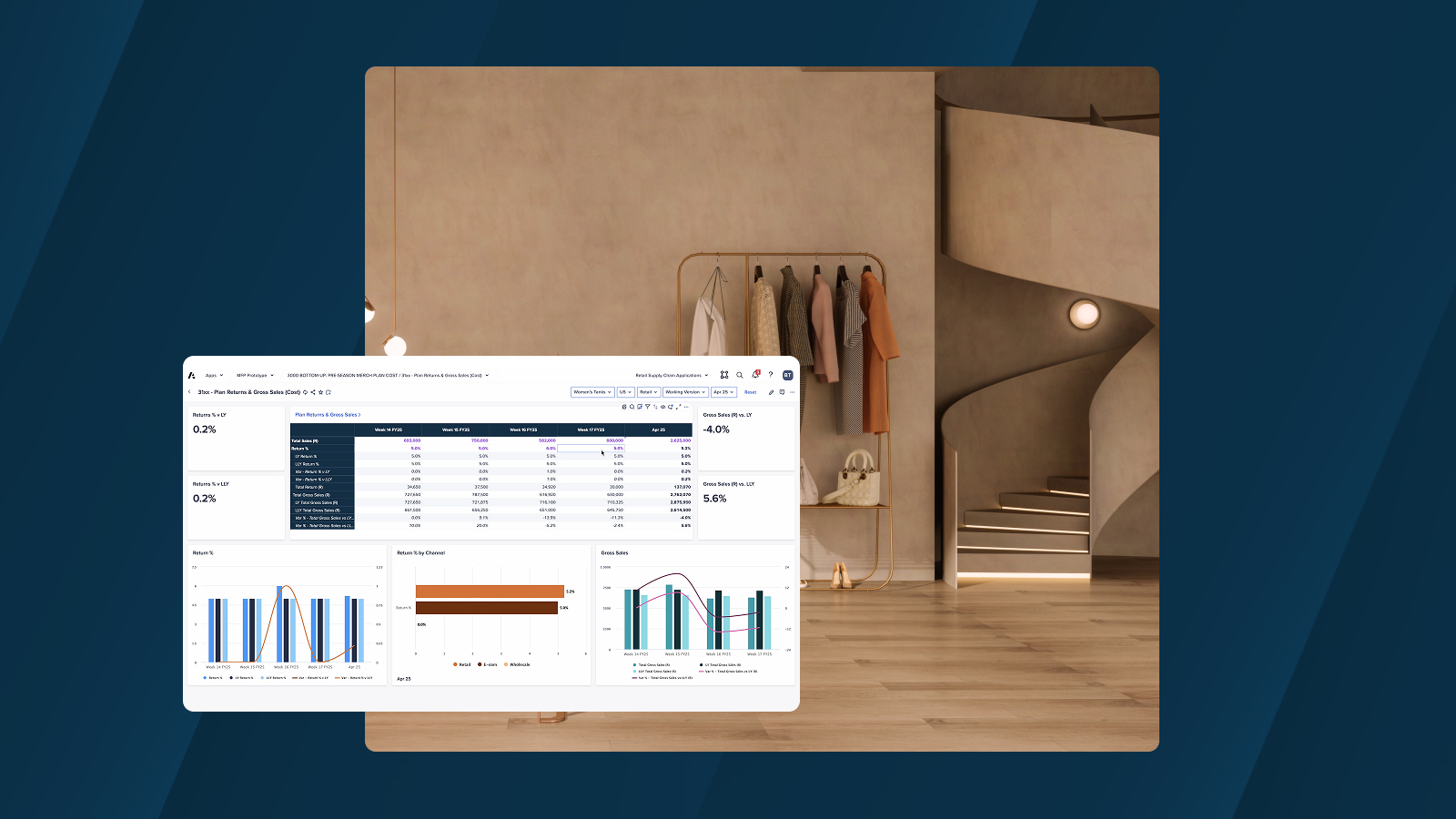
Anaplan’s Size Optimization application combines AI-driven size-curve generation, localized demand insights, and simplified buy quantification in a single connected workflow. Planners remain in control throughout, adding their expertise to create sized buys that nail margin performance goals.
Our scientific approach to sizing starts with Anaplan’s advanced AI demand forecasts, tuned for retail and capable of automatically controlling for stockouts and data sparsity. Granular forecasts are paired with a proprietary attribute similarity engine, which leverages in-house neural network models to identify unique associations between size-specific demand patterns and product/store attributes.
Planners fine-tune the resulting size curves in a dedicated visual sizing workspace, and purchase quantities remain in lockstep with each change thanks to dynamic calculations that take milliseconds to execute and automatically apply business rules like presentation minimums.
The end result? Purchase-order-ready buy quantities mathematically likely to meet demand appropriately for every size across your entire assortment.
What results can retailers expect from smarter size optimization?
A leading athletic apparel brand working with Anaplan’s Size Optimization application unlocked an estimated $72 million in annual revenue by reducing early-season stockouts on high-demand sizes and preventing late-season clearance markdowns on overstocked fringe sizes — alongside a 7% uplift over baseline curve accuracy at the store level.
Accurate size availability has become a competitive differentiator. Customers who consistently find their size build a quiet but powerful loyalty to the brands that deliver it — and increasingly, the brands that can’t are at risk of losing ground to those that can.
How can retailers improve size planning?
For retailers ready to move beyond generic size curves, Anaplan’s Size Optimization application combines AI-driven forecasting with localized demand insights, business rules, and planner expertise to provide a more intelligent way to plan. It helps improve inventory productivity, reduce markdowns, minimize stockouts, and give customers a better chance of finding the right size the first time.
Discover how Anaplan’s AI-driven Size Optimization application helps retailers create more accurately sized buys, reduce manual effort, improve inventory productivity, and turn better demand signals into better buy plans.