Key takeaways:
We need to talk about the realities of AI agents working their way into your workforce.
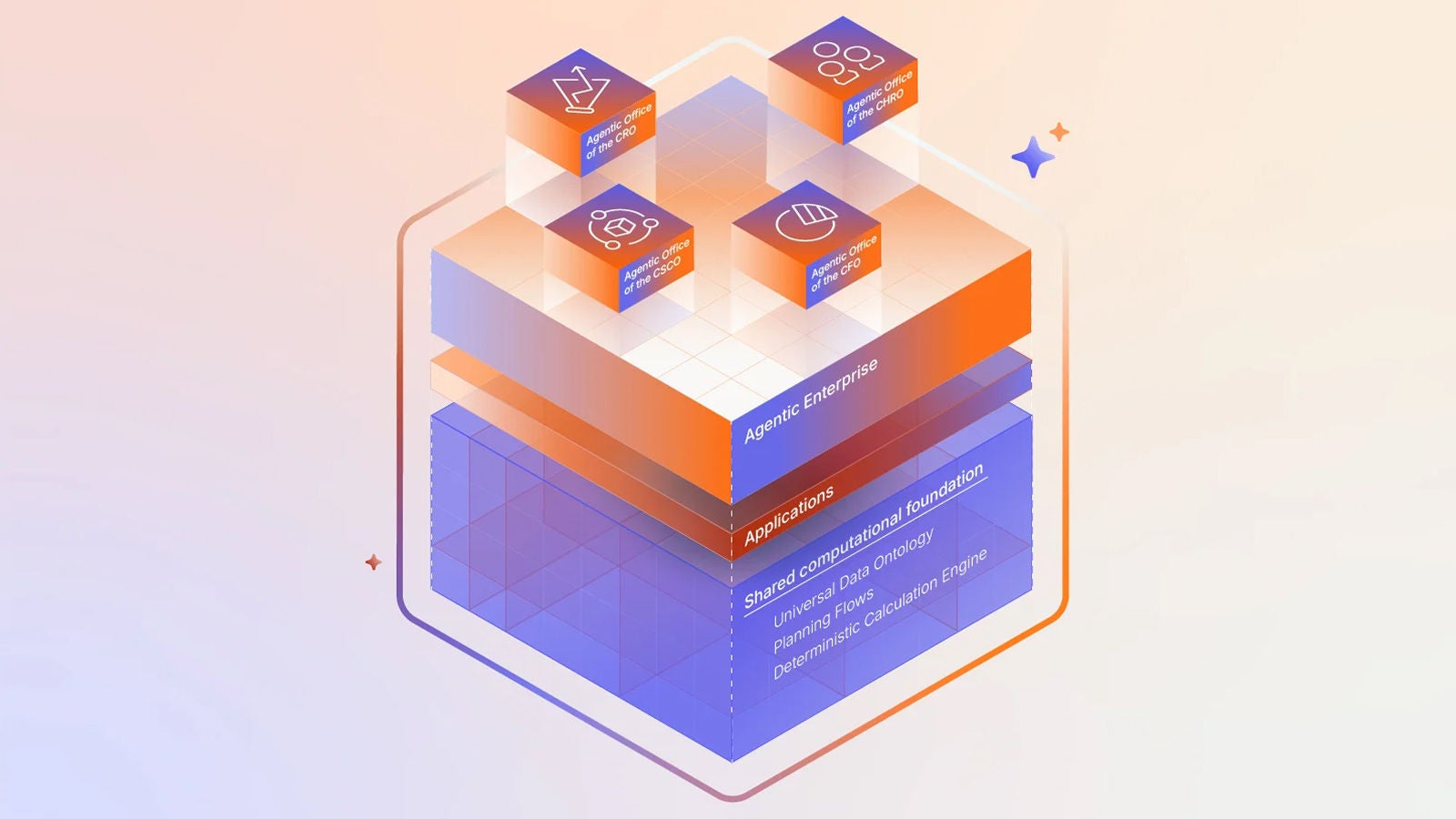
As HR, finance, and business leaders today are looking toward the "Agentic Enterprise" — a future where AI agents work alongside humans to drive complex workflows — it’s a natural evolutionary step in business efficiency, but it requires us to significantly adjust how we model and plan our organizations. Why exactly is this the case?
Adding AI into the workforce is introducing a brand-new set of variables.
Traditional workforce planning is historically grounded in human-centric constructs: headcount, org charts, salaries, benefits, and linear career paths. The Agentic Enterprise, on the other hand, operates on entirely different physics: API calls, AI token calls, compute costs, continuous learning models, and autonomous execution that doesn't neatly fit into a traditional reporting structure.
It’s a compelling puzzle: How do you structure, forecast, and plan for a workforce that is designed to be autonomous and non-traditional? The reality is that many organizations are trying to map the workforce of the future using tools and mindsets that were built for a simpler time.
Some market commentators suggest this represents an unmanageable shift, and that organizations are attempting to "plan the unplannable."
We don't buy that. The future of work is entirely plannable; we just need to upgrade our foundational systems and adjust for the additional variables to improve our decision accuracy decisions.
The AI readiness gap in HR
If you think incorporating enterprise AI agents is a problem for the next decade, the world's leading analysts have a wake-up call for you.
According to Gartner, by 2028, agentic AI will make up to 15% of day-to-day business decisions autonomously. At the same time, Forrester projects that 60% of enterprises will implement agentic AI-powered HR solutions to automate workflows and shift work.
As Mercer’s Global Talent Trends report highlights, organizations have reached a critical tipping point. Yet, enterprise AI ambitions are currently advancing much faster than HR readiness. Most organizations are still trying to solve the new "human-machine equation" using siloed spreadsheets or legacy human capital management (HCM) systems that were never designed for complex, multi-dimensional modeling.
Discover how HR and finance leaders are modernizing their workforce planning and closing the AI readiness gap. Get the benchmark data and top priorities in our exclusive research report: The state of workforce planning: Trends, tools, and gaps.
Why the traditional FTE metric must evolve
In the rush to capture AI efficiency, some headlines claim that the traditional full-time equivalent (FTE) is dead.
While that perspective makes for provocative headlines, it is far from reality, and it creates unnecessary fear. Human talent and creativity remain the core engine of enterprise ingenuity. The goal of the agentic shift should not be a panic-driven reduction in headcount, but instead, it should be about learning how to successfully orchestrate a hybrid ecosystem of human talent and AI agents. You cannot plan a hybrid human-AI ecosystem by treating digital capability as a static head in an organizational chart.
However, to do this, your planning metrics must evolve across three fronts:
- The talent pipeline is morphing: Anthropic's CEO sparked a major industry debate by predicting that AI could eliminate 50% of all entry-level jobs (a claim that he later walked back). But this still highlights a looming vulnerability. If the work of entry-level employees is redirected to AI, how do you onboard, train, and develop the next generation of senior leaders? Without a clear development and succession plan, you risk a future talent vacuum — or missing out on younger, creative and AI-fluent talent who could accelerate your transformation.
- The cognitive load is shifting: As AI handles routine and repetitive tasks, the human workload concentrates on high-stakes, highly skilled, emotionally demanding complexities. Organizations should consider creating agent experience (AX) programs to prepare employees to collaborate with digital counterparts without burning out.
- Operating expenses (OpEx) are transforming into tech spend: When a digital agent takes over a workflow, payroll costs immediately shift to variable compute, AI token, and API costs. Traditional HR and financial planning tools do not have the vocabulary to translate human capacity and costs into cloud infrastructure requirements.
Common enterprise HCM and HR systems cannot accurately calculate these multidimensional, real-time ripple effects. This means that HR and finance leaders don't need to eliminate the FTE metric, but rather, expand their models so they can understand how humans and machines create value together.
Why enterprise workforce planning requires more than generic language models
Generative AI has heavily indexed probabilistic text generation — chatbots that retrieve and summarize information. But for enterprise planning, AI must compute answers with absolute precision and not just tell you what it wants you to hear.
Generic large language models (LLMs) fall short at multi-step algebraic manipulation and complex modeling; they deal in likelihoods rather than precision, which is critical — especially when it comes to finalizing global hiring plans, balancing union labor rules, or calculating localized compensation brackets. If a workforce plan miscalculates hiring targets for critical engineering skills by 5%, or over hires expensive talent in the wrong region, it results in millions of dollars in wasted budget or severe project delays.
Furthermore, trying to run complex, multi-dimensional scenario modeling entirely inside a generic LLM is extraordinarily expensive. The token consumption alone could drain enterprise capital.
To safely enable agentic AI, enterprises must combine the conversational reasoning power of LLMs with a rigid, deterministic planning engine.
Create future workforce plans with precision
This is exactly where Anaplan's workforce planning solutions bring order to the chaos of the hybrid workforce by bridging the gap between speculative AI-driven forecasting and accurate operational math on a single, connected platform.
Anaplan's AI-driven planning solutions uniquely solve the human-machine equation by pairing probabilistic foresight with deterministic precision:
- Probabilistic foresight (Predicting the unknowns): Powered by agentic AI capabilities (such as Anaplan CoModeler and Custom Analysts), Anaplan introduces an intuitive, probabilistic experience to enterprise planning. Rather than relying on rigid, pre-configured templates or manual inputs, AI agents act as intelligent co-planners. They interpret natural language intent, reason over complex workforce datasets, proactively surface risks, and generate recommended scenario options. This gives leaders and planners the speed and flexibility to explore possibilities and test hypotheses conversationally.
- Deterministic precision (Grounding plans in reality): Once a scenario is proposed, Anaplan’s proprietary, in-memory calculation engine takes over to run the precise, rule-based math. It delivers accurate answers at a marginal cost of almost zero and without any "LLM hallucination." Anaplan's predictive AI handles the variable aspects of future work. It models attrition rates, identifies hidden skill gaps, and forecasts talent supply and demand. It gives you the most likely future states to plan against. Every result is mathematically sound, auditable, and traceable to its source.
By unifying generative, probabilistic LLMs with a deterministic calculation core, HR, finance, and business leaders can make their biggest workforce decisions with total confidence.
Strategic planning capabilities for the hybrid workforce
With Anaplan, CHROs gain purpose-built, HR and workforce planning capabilities to confidently manage the hybrid workforce:
| Core capability | The benefits | Real-world example |
|---|---|---|
|
Dynamic scenario planning |
Test multiple "what-if" futures instantly, grounding speculative AI forecasts in exact financial realities. |
Modeling operational risk: "If our digital customer service agents go offline, do we have the human headcount buffer to absorb the immediate escalation queue?" |
|
Synchronized cost and capacity |
Bridge the gap between human payroll and digital agent usage to align HR, finance, and IT. |
Instantly calculating how automating a manual workflow shifts costs from employee salaries (HR budget) to AI and API usage (IT/finance budget). |
|
Skills-based workforce planning |
Map and forecast the actual skills your business needs as routine tasks are automated by AI. |
Identifying that AI will absorb 60% of tier-1 support work, and proactively building a training pipeline to upskill the impacted workers into high-value tier-2 roles. |
Are you ready for the shift to agentic?
The Agentic Enterprise is a rapidly scaling operational reality that we are fully capable of planning. The organizations that win will be the ones that learn how to effectively plan, optimize, and pivot their hybrid workforce in real time.
Traditional, flat headcount planning cannot handle this complexity. As your organization deploys its first wave of AI agents, ask yourself: Does your current HR infrastructure have the computational power to orchestrate AI alongside your human talent, or are you still trying to plan the future with the spreadsheets of the past?