Key takeaways:
How does AI improve financial consolidation?
AI can be used to automatically detect metadata anomalies and suggest accurate chart of account mappings. This dramatically reduces manual corrections, accelerates your group close time, and ensures high data integrity across the enterprise.
For organizations that leverage mergers and acquisitions (M&A) as a growth strategy, the rewards can be substantial. Bain & Company found that companies engaging in M&A deliver significantly higher shareholder returns than those without. The challenge, however, isn't just in making the deal, but in how quickly the business can derive value from it. Success often comes down to having a modern toolset to navigate the complexities of subsidiary integration.
The immediate aftermath of an acquisition typically introduces a significant initiative for the corporate controller and finance team. The parent company and the acquired company almost always have completely different ledger structures and financial systems. This makes the first group close — a crucial stage on the path to the official handover of ownership — a particular challenge.
Getting there means clearing a few specific roadblocks. The parent company and its new subsidiary often use different ERPs, accounting software, and charts of accounts, so the data underneath doesn't line up before anyone's touched it.
From there, every manual step compounds the problem: Mapping, extracting, and combining data manually is exactly where human error creeps in, and differences in accounting policies, payment schedules, and reporting calendars turn small mismatches into real bottlenecks.
Moving beyond manual data integration, and letting AI map disparate financial data instead, accelerates how quickly an acquisition can start paying off.
The manual mapping nightmare
The processes that underpin financial consolidation are often still grounded in disconnected spreadsheets and legacy point solutions. This compels finance teams to spend days — or sometimes weeks, depending on the complexity of the new subsidiary — cross-referencing offline sources, hunting down anomalous metadata, and manually mapping a local chart of accounts into the parent company’s reporting structure.
These disconnected processes have a profound impact on the business’s ability to report on the newly formed entity. When data integration creates extraordinary drain on resources, you inevitably struggle to produce timely, accurate, consolidated financial statements. This in turn delays mandatory group reporting. Executive visibility into the actual combined financial performance is limited, while the stakeholders who need a clear, compliant picture of the business are left frustrated.
Meanwhile, time spent making multiple rounds of adjustments, validating data, and correcting data constrains your ability to shift your attention toward higher value analysis. AI doesn't just speed up post-acquisition financial consolidation; it removes most of the manual work that made it slow in the first place.
Accelerating time-to-value with AI-assisted mapping
With AI, standardized mappings, automated data flows, and consistent structures streamline financial consolidation, improving accuracy and minimizing rework. This drastically reduces the time you need for the group close.
Automation replaces manual, error-prone activities, including chart of accounts mapping (CoA). For example, AI-assisted mapping can generate confidence-based suggestions that allow users to map external CoA members with greater speed and intelligent guiding.
Complex intercompany accounting processes are executed in real-time, automatically matching intercompany transactions and flagging discrepancies for review.
AI fundamentally shifts the controller's role from a data custodian to a strategic partner. With automation reducing the recurring effort required to prepare consolidated results, your team spends less time on tasks such as validating inputs and correcting mappings. This frees them up to focus on review and analysis. The finance team can access and query data without relying on IT to collate and reformat it: everything is right there at their fingertips.
AI also closes the trust gap that manual chart of account mapping leaves behind. Users can quickly review, accept, or edit the proposed mappings, scanning and suggesting mappings for thousands of unmapped lines in seconds.
Achieve operational status in weeks, not months
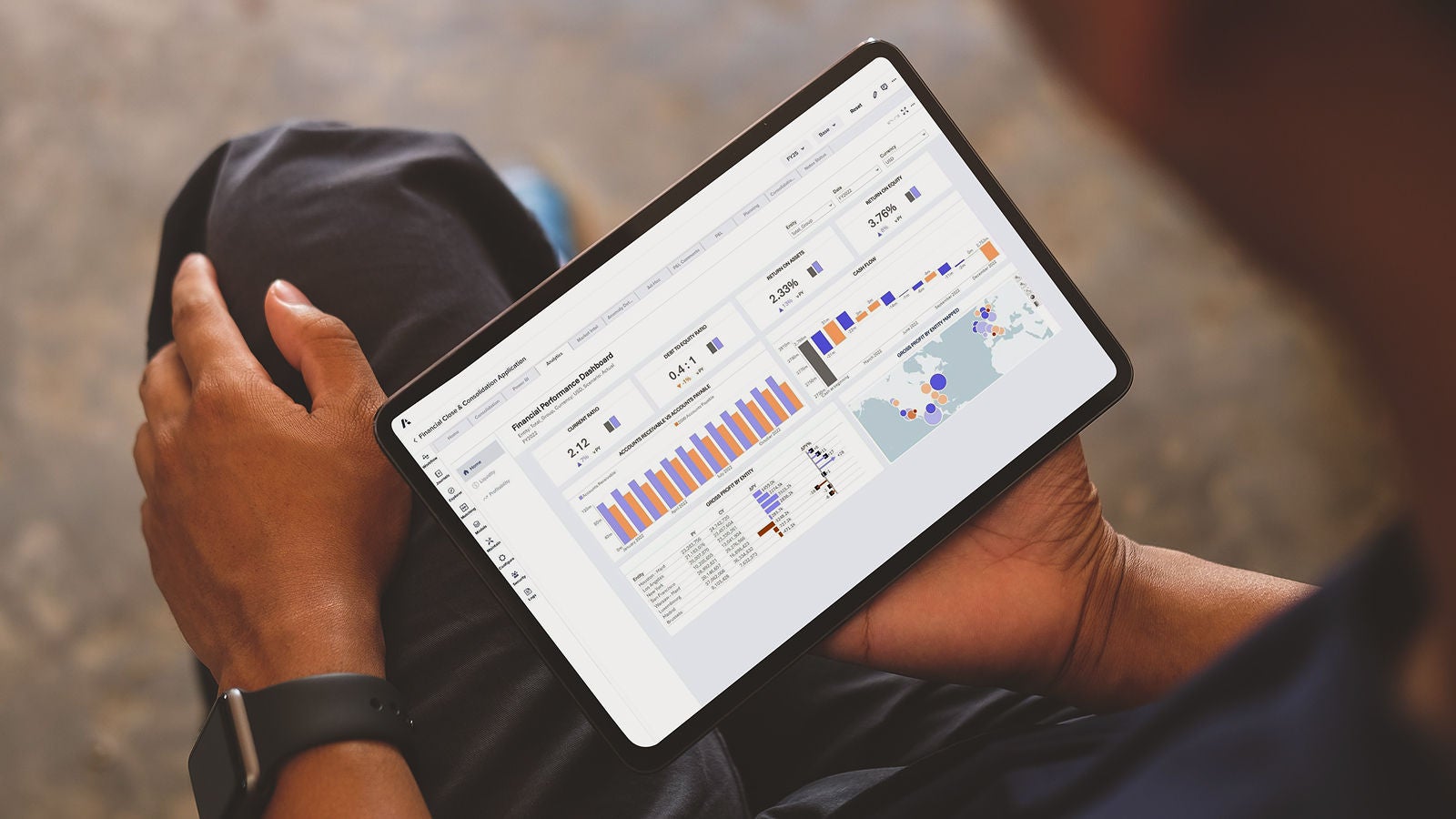
The Anaplan Financial Consolidation application enhances your ability to seamlessly absorb new acquisitions and report in a timely, more accurate way. Our extensive use of pre-built and configurable logic, calculations, and reports that come out-of-the-box ensure your team implement and deliver value quickly, streamline complex accounting processes, and increase efficiency across group close and consolidation activities.
We’ve quadrupled our revenue, but [with Anaplan], my staff is still a dozen people.
VP, controller, healthcare
Finance teams realize the benefits from the outset:
- The application connects the data from ERPs, general ledgers, and financial and operational systems across every subsidiary and geography you are absorbing, so integration isn’t a separate project bolted onto the deal.
- AI-assisted chart of account mapping detects and suggests correct mappings, cutting out most of the manual correction that consumes your team’s time.
- Built-in audit trails and reporting that meets global standards, such as US GAAP, IFRS, and ASPE, are a function of using the system, not a separate compliance exercise layered on top.
What are the benefits of using Anaplan for financial consolidation?
Anaplan recaptures time lost to manual data adjustments and legacy on-premise solutions. The Forrester Total Economic Impact™ study calculates the bottom-line benefit as a 152% ROI over a three-year period, with organizations experiencing a $4.3M gain solely from increased efficiency across group close and consolidation activities.
Faster onboarding equals faster value
The ability to integrate a newly acquired business quickly and effectively is becoming a competitive differentiator. The organizations that determine how to capture value soonest are not necessarily those that make the most acquisitions, but those that can rapidly establish a trusted, unified view of financial performance across the combined enterprise.
AI doesn't just make post-acquisition financial consolidation faster — it turns it into a strategic enabler. Finance leaders who get this right today won't just close their books faster on the next deal. They'll be the ones their board trusts to deliver the synergies that the deal was supposed to justify.