Key takeaways:
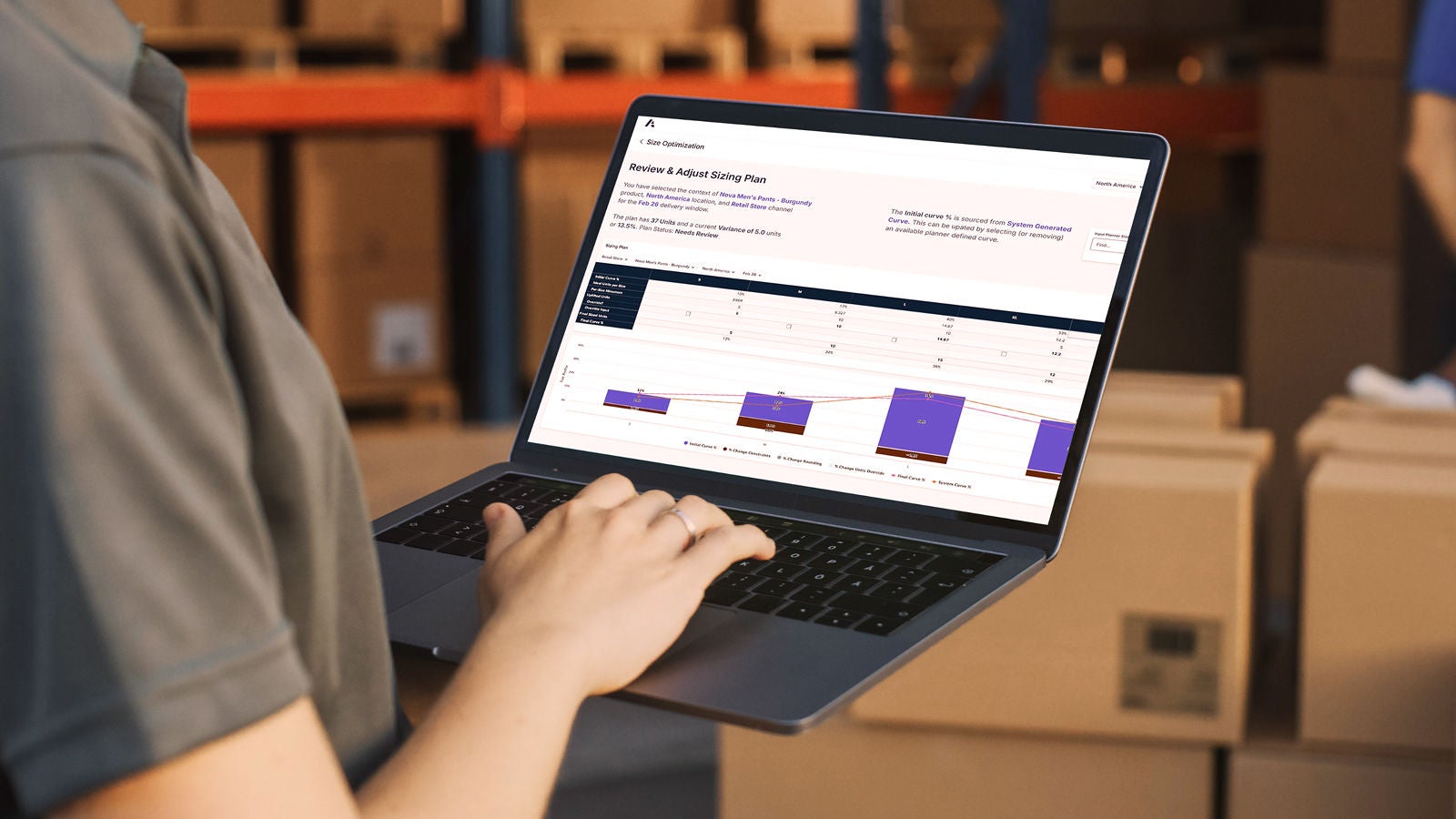
When we announced Anaplan’s Size Optimization application, we focused on how it transforms retail planning workflows — giving buyers and planners the tools to build localized, highly accurate buy plans without getting bogged down in spreadsheets.
While that announcement highlights the end-user workflow and commercial benefits, as a data science team, we’re equally excited about what’s happening under the hood. Sizing is often where retail margins quietly erode: a few percentage points of error in a size curve translates directly into markdowns on overstocked fringe sizes or missed revenue from stockouts on core sizes.
Building on our high-level guide on smarter size curves, today I want to pull back the curtain on the actual data science and machine learning architecture powering our sizing engine. But first, a bit on why.
If you’ve built out size curves before, you’ve probably run into at least one of these common challenges. Your forecast captures high-level averages (maybe category or channel level), with no insight into individual items or locations. Or your forecast tracks historical SKU patterns well but offers no insight into attribute- or store-based trends. And maybe the hardest one of all: your assortment is heavy on newness with no obvious comps.
Each of these is a thorn in the side of any planner in their own right. So we decided to build a solution that tackled them all at the same time. We’ve completely re-engineered how we model size curves to solve the hardest problems in pre-season buying — problems an off-the-shelf model will never be able to address.
How our engines power the Retail Intelligence suite
To understand how our sizing engine works, it helps to look at how we build technology at Anaplan. The engine doesn’t operate in a vacuum; it sits within our broader Retail Intelligence suite, where specialized mathematical engines handle complex forecasting, clustering, and optimization challenges across the retail lifecycle.
If our data science engines represent the high-performance powertrain under the hood, our applications are the cars built on top. An engine on its own produces powerful mathematical insights, but planners need a structured vehicle to drive those insights into daily decisions. By pairing our sizing engine with Anaplan’s Size Optimization application, we connect tailored machine learning predictions directly to purchase-order-ready workflows structured around retail best practices.
Here is an insider’s look at the neural architectures, data pipelines, and engineering principles that shape our sizing engine.
Deep dive: How Anaplan’s sizing engine addresses pre-season buying challenges
From constrained sales to true demand (correcting for stockouts)
Raw sales data only reflects what was available to buy, not what customers wanted to buy. If size medium sold out in week two, historical sales will show zero medium sales for the rest of the season — leading naive models to mistakenly conclude demand for medium fell to zero.
Our engine explicitly corrects for stockouts by integrating inventory availability data directly into the feature pipeline. By distinguishing a true lack of demand from an inventory stockout, the model infers unmet demand and trains on unconstrained demand. This ensures our forecasts capture genuine customer preference rather than repeating past supply chain mistakes.
Solving the cold start: Learning from similarity, not just history
Traditional size curve modeling works at either the isolated article level (which fails for new items with zero sales history) or the rigid size-set level (which groups unrelated products simply because they share a size run).
To solve the pre-season “cold start” for new styles, our pipeline utilizes text embeddings and metadata. We translate rich product text descriptions, material properties, garment fit, style taxonomy, and store attributes into dense numerical vectors.
These embeddings feed into neural network architectures that construct a shared mathematical space of similarity. The engine borrows statistical “DNA” from comparable historical items to confidently assign an accurate size curve to a brand-new style before a single unit is sold. Furthermore, when a new size (e.g., XXL) is added to an existing assortment, the model gracefully infers its share from learned attribute patterns rather than defaulting to zero.
Smart boundaries and uncertainty-aware learning
Generating raw neural network outputs is only half the battle. Ensuring mathematically valid and robust predictions is critical for downstream execution.
- Guaranteed size scope boundaries: At inference time, the model consumes the merchant’s assortment plan and applies a boundary constraint function. This guarantees that predicted demand sums to exactly 100% distributed only across the sizes explicitly available for that specific SKU/location combination. Invalid or out-of-scope sizes are assigned a strict 0% share, removing the need for manual cleanup by planners.
- Filtering noise with uncertainty-aware learning: Sparse sales in low-volume stores or niche categories produce noisy, volatile curves. To prevent small unit swings from corrupting the model, our training objective incorporates uncertainty-aware loss functions. Errors on low-volume, noisy observation targets are mathematically down-weighted, ensuring the neural network trusts high-confidence signals while remaining resilient to random transactional noise.
Measuring sizing success: From backtesting to bottom-line ROI
As a data science team, we don’t judge our models solely on algorithmic elegance. We measure success on the exact metrics our retail customers care about: forecast accuracy, stockout reduction, markdown avoidance, and gross margin return on inventory.
Before any model goes live, we subject it to rigorous rolling-window backtesting evaluated via wMAPE (Weighted Mean Absolute Percentage Error) on units sold. Crucially, our backtesting framework enforces a lead time gap between the training cutoff and evaluation horizon to mirror real-world pre-season sourcing timelines.
When deployed in production, this market-beating architecture delivers proven operational impact:
- Leading global apparel retailer: Achieved a 3% accuracy improvement over existing sizing baselines, equating to an estimated $8M in gains for a subset of their business.
- Leading athletic apparel brand: Unlocked a 7% accuracy uplift over the existing baseline at the store level, driving an estimated $72M in annual revenue unlock.
Ready to modernize your approach to retail sizing?
By combining neural text embeddings, stockout correction, uncertainty-aware learning, and automated profile clustering, our sizing engine bridges the gap between deep machine learning and practical retail execution.
Discover how Anaplan’s Size Optimization application brings these data science breakthroughs into intuitive, daily planner workflows.