Finding the power in data
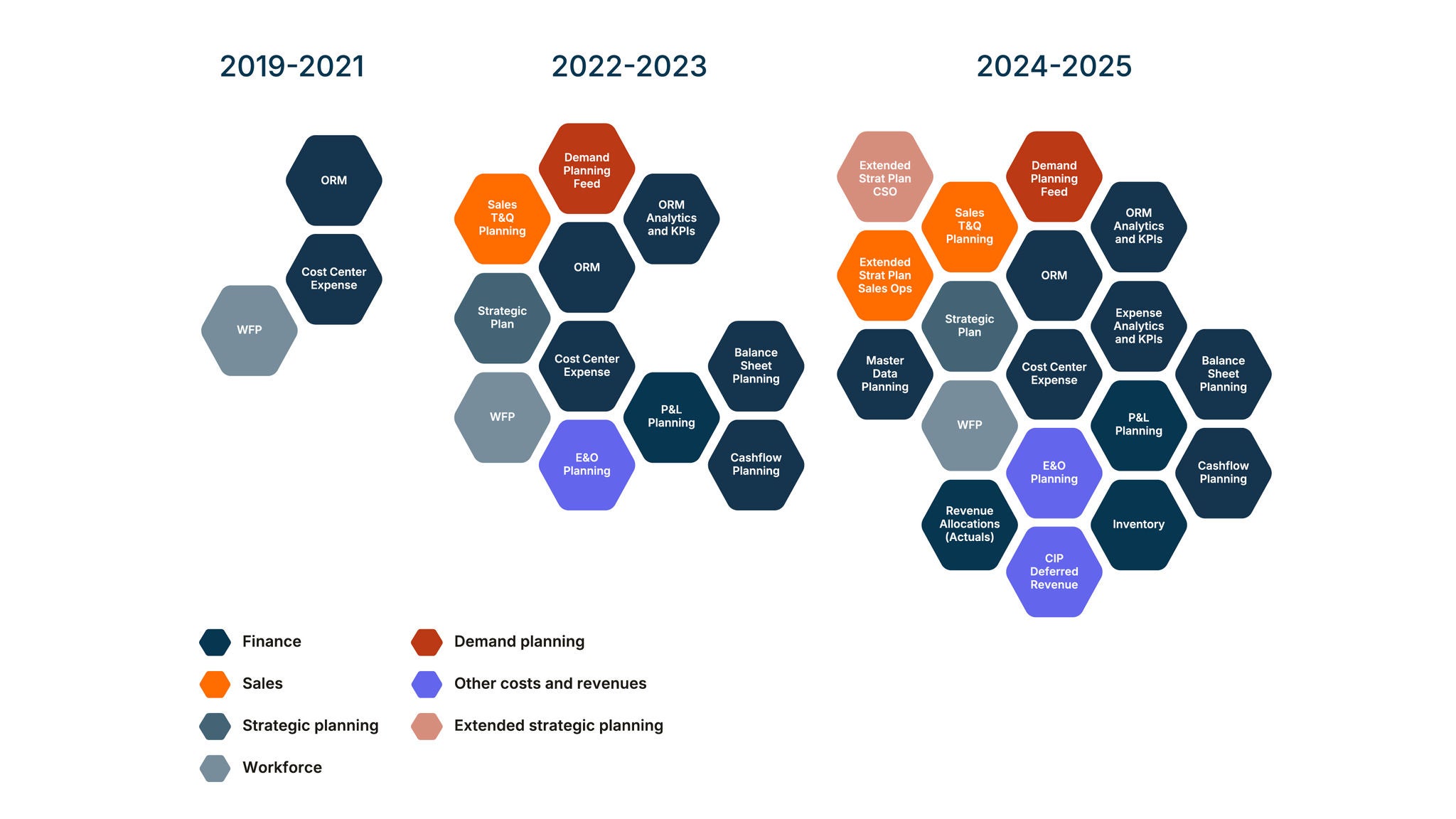
Ciena launched its Anaplan journey in 2021 with Cost Center Expense, a model that integrates data from CRM, ERP, and various bid- and contract-management tools. That was followed quickly by Workforce Planning and Orders-Revenues-Margins (ORM) models. Since then, Ciena has steadily rolled out additional use cases each year, and at last count had 18 Anaplan models across seven business units.
Why so many? Ciena is a sprawling organization, and teams throughout the company receive different market, customer, product, or vendor signals along different time horizons. The strategic planning processes in Anaplan enable the company to connect and integrate them all.
Of the many Anaplan use cases at Ciena, two of the earliest ones — Cost Center Expense and Workforce Planning — serve as the foundation for the growth that followed because they connect people plans with finance. “We’re able to understand what teams and what roles are required for the future, and where we’re at right now in terms of budget, costs, and everything that needs to be allocated at an organizational level,” explains Jo Youn, Ciena’s Manager of Global Sales Compensation.
Ciena’s ongoing emphasis on workforce planning aligns with its corporate culture. “We pride ourselves on being people-driven,” Soukup said in an Integrated Workforce Planning research paper prepared by The Josh Bersin Company. “Our C-suite speaks to the value of bringing people into the right roles where they can do the right things, as that will help all else fall into place.”
The team at Ciena that manages the Anaplan environment is focused on operational excellence and supporting the user community, while driving toward key capabilities across the company.
The development team primarily uses classic model-building, while leveraging Anaplan platform technologies including Anaplan Workflow and Anaplan Polaris. The team works in collaboration with a key Anaplan partner.
Data governance provides high-quality AI signals
The Anaplan models contribute to near-real-time integrated planning by cleaning and structuring data so it is AI-ready. Outputs from Anaplan are used for a consensus monthly sales forecast; long-term forecasts of revenue, costs, and margins; consolidated financial statements and workforce plans; and cost modeling for new products.
Ciena’s integrated planning environment runs on massive volumes of data, Much of the HR, ERP, and CRM data comes into Anaplan via a Snowflake data warehouse. (Snowflake also handles anomaly detection.) Data governance is overseen by an IPB Council that makes sure that the data is fit to drive financial decisions. “Rather than just sales and supply chain, we [on the IBP Council] have a conversation led by finance,” Soukup explains. “Because at the end of the day, Ciena needs to hit our financial objectives — and sales and supply chain are the two enablers for us to do that.”
More than 80% of Ciena’s transactional data flows into Anaplan and sets the stage for AI-powered analysis. Soukup estimates that automated data integration alone saves Ciena’s people 30,000 clicks a week while supporting impartiality. “Curated data with a lot of human bias is not good for AI,” Soukup says. “Our data governance programs evolve to make sure that we continue to have the best possible AI signal going forward.”
Bringing diverse data sources into Anaplan enables direct connections between processes and teams that were formerly siloed. As an example, Soukup cites a connection between the demand plan and Ciena’s revenue call. “Instead of having supply chain ingest sales information to create a demand plan, we provide the demand planning team with a true revenue signal at the level of detail they require,” he explains. “That way, demand planning is informed by the revenue plan, rather than trying to triangulate between different signals.”
Removing barriers, accelerating growth
In finance, automation and new processes built on the Anaplan platform have enabled a shift in workloads throughout the company. Financial planning and analysis (FP&A) personnel who spent 80% of their time assembling data before Anaplan now spend 80% of their time on analysis, which has both accelerated processes and elevated their professional lives. “Over the past four years, we've been able to reduce our planning time by over 50%,” Soukup says. “We are now seeing finance people become finance people again.”
Faster processes in Anaplan also give decision-makers data they need while there’s time to act on it. For example, Ciena leverages the Anaplan platform to stay agile as various tariff proposals were floated. In less than a week, Soukup built functionality in Anaplan that provides real-time calculations of revenue adjustments from tariffs, along with their impacts on forecasts. The process leverages data from Oracle, Revstream, and Salesforce, managed and replicated in Snowflake. Key to the process was the ability to generate “with-tariffs” and “without-tariffs” scenarios, which have facilitated accurate revenue planning and customer communication.
Beyond finance, Youn says the value of Anaplan in sales planning has come from connection and democratization across the company’s go-to-market teams. “We have a sales population that is on our Anaplan model,” she says. “All of our territories and quotas are set up there. Being able to use real-time, efficient, and effective decisions has helped us tremendously to accelerate our growth into a multibillion-dollar business.”
Capabilities like these — coupled with Ciena’s market-leading products — help the company maintain its position at the top of its industry. “Being able to detect changes in the plan and be able to respond to them quickly is going to allow us to keep in front of the market,” Soukup concludes.