Key takeaways:
There was a time when the annual planning cycle made sense. Conditions were stable enough that locking in assumptions for twelve months was a reasonable bet. Budgets were set in Q4, reviewed at mid-year, and adjusted in the following cycle if at all.
That world is long gone.
The pace and nature of disruption have changed how planning cycles work. Supply chain shocks, geopolitical instability, rapid demand shifts, and labor market turbulence are no longer one-off, episodic events. They arrive simultaneously and continuously and, as a result, they require simultaneous and continuous planning adjustments.
Strategic business decisions can't be put off for even a quarter anymore. They now need to happen in days, or hours.
The result is a widening gap between how fast the business environment moves and how fast organizations can respond. Traditional, linear planning cycles aren't just slow — they're structurally mismatched with the reality they're meant to address. AI-driven planning is what closes that gap, but only when it's the right kind of AI for the job.
When traditional planning cycles fail, what replaces them?
The failure of traditional planning is a structural problem — one built into the assumptions that traditional planning cycles were designed around.
Traditional planning draws on historical data, for example, last quarter's performance and last year's trends. By the time that data is collected, cleaned, consolidated, and analyzed, the conditions it reflects may already be obsolete.
Finance plans separately from supply chain, which plans separately from workforce, which plans separately from sales. When a disruption cuts across all those functions, as most modern disruptions do, the organization lacks the connectivity to understand the full impact or coordinate a coherent response. This leaves organizations perpetually behind, responding to the last disruption while the next one is already in play.
What's replacing the traditional model isn't a faster version of the same thing. It's a fundamentally different approach built on three capabilities.
- Scenario modeling that moves from a once-a-year exercise to a continuous capability. Leading organizations run scenarios constantly, testing assumptions, stress-testing decisions, and building contingency responses before they're needed. When disruption arrives, the path forward has already been modeled.
- Dynamic forecasts that replace static targets. Business drivers change, commodity prices shift, customer demand evolves, headcount assumptions move. A dynamic forecast doesn't just update the numbers; it recalculates the entire plan as those underlying factors change, automatically adjusting across functions so every decision reflects current reality, not last quarter's assumptions.
- Real-time operational signals that feed the planning process directly. When inventory shifts, when a supplier signals a delay, when demand in a key market shifts, that information enters the planning model immediately rather than waiting for the next reporting cycle. The plan becomes a living system, not a static document.
Where AI changes the equation and what it must get it right
AI is transforming what's possible in enterprise planning. But not all AI is the same, and for planning and decision-making specifically, the distinction matters enormously.
Most AI — the kind behind chatbots, content generation, and conversational tools — is probabilistic.
It works by generating the most statistically likely answer based on everything it has learned. That makes it powerful for brainstorming, summarizing, and exploring ideas. But it also means it tells you what you want to hear. It produces a plausible, confident-sounding answer. This answer can still be subtly, or significantly, wrong and there is no way to audit why it arrived there.
For planning and financial decision-making, plausible isn't good enough.
You wouldn't accept a financial forecast that is "probably" right. You can't run a supply chain model that sends inventory to the wrong location 5% of the time because it seemed statistically likely. When a CFO signs off on a plan, when a board reviews a scenario model, when the financial conditions tied to the debt agreement change, the number has to be right, and it must include an audit trail.
This is where deterministic AI becomes critical.
Unlike probabilistic AI, a deterministic system computes a single, verifiable answer based on defined logic and governed data. Given the same inputs, it produces the same output every single time. The result is traceable, auditable, and defensible.
The different roles of probabilistic and deterministic AI
Both types of AI have a role to play in modern planning. Probabilistic AI is valuable for pattern detection across massive datasets, for surfacing signals and anomalies a human analyst would miss, for generating scenario hypotheses, and drafting executive narratives. It accelerates the front end of the planning process.
But when the business driver changes, when raw material costs shift, when demand in a key region moves, when a new constraint enters the model, the recalculation that follows has to be exact. The deterministic engine takes over: recomputing the full impact across finance, supply chain, workforce, and operations with 100% accuracy, producing outputs that can go straight to the people who need to act on them.
Precision and confidence in planning decisions are built on a foundation that computes, without guesswork at any stage of the process.
Planning as a continuous decision capability
The organizations that are winning today aren't the ones that plan better just once a year. They're the ones that have adapted their planning as a continuous capability, where every function operates from shared assumptions, where changing factors flow through the model in real time, and where every critical decision is tested against a foundation of verifiable truth before it's made.
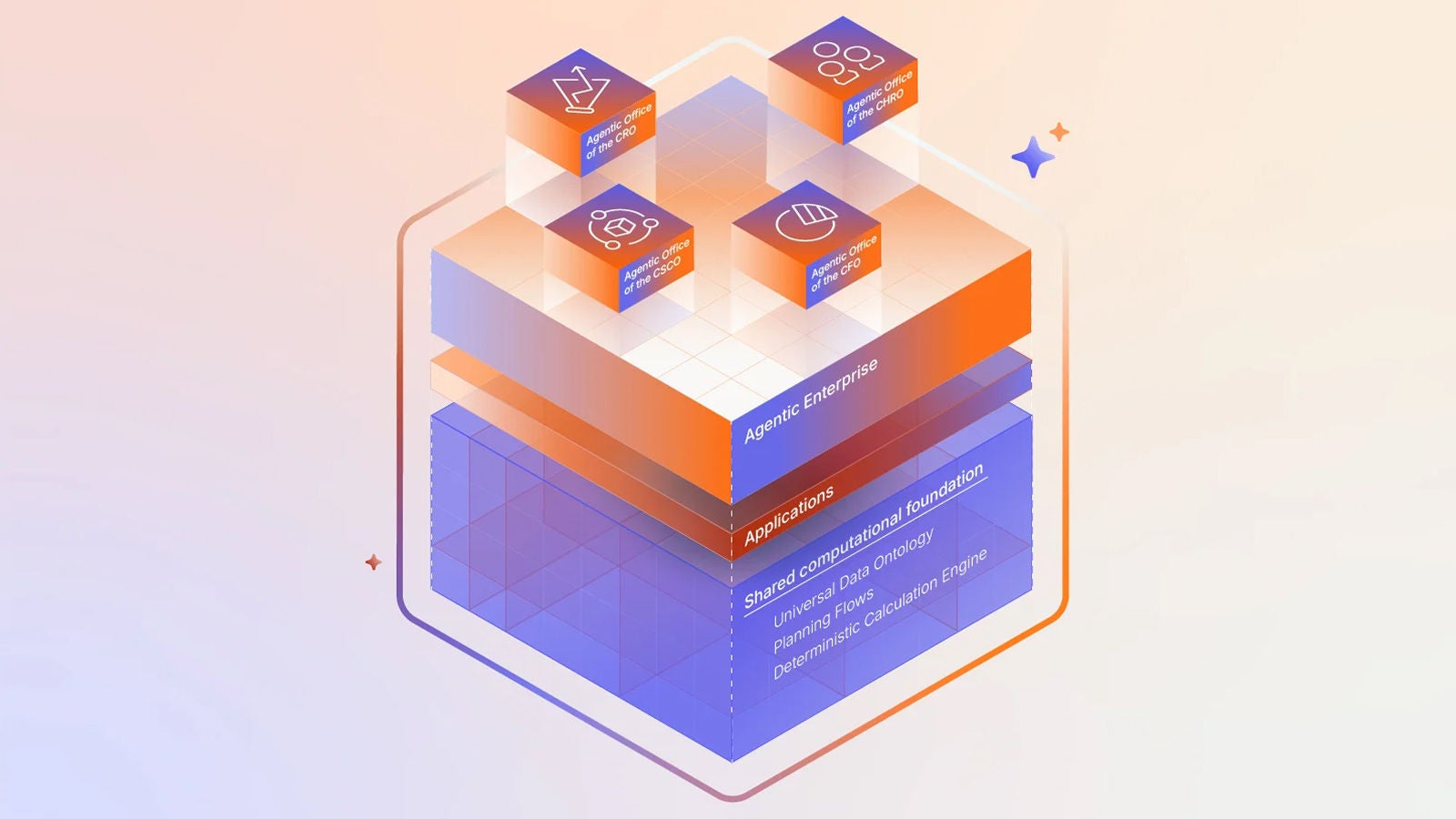
Anaplan was built for this fundamentally different operating model, where planning is continuous and decisions are tested before they're made. The platform connects finance, supply chain, sales, and workforce in a single unified data model that reflects the full impact of every change.
When business drivers shift — a tariff, a demand signal, a supply constraint — Anaplan's deterministic engine recalculates automatically across every connected dimension of the plan. The dynamic forecast isn't a new document to be built; it's already accurately reflecting what just changed.
Anaplan supports action
Consider what it means to test decisions before they happen. A CFO can ask what the impact of a two-quarter delay in European expansion would be on operating margin, covenant compliance, and workforce planning — and get a governed, auditable answer in minutes, not days.
That answer doesn't come from a probabilistic estimate. It comes from the organization's real data, actual cost structure, and contractual commitments, computed by a deterministic engine that delivers outputs you can sign off and present to a board.
With Anaplan, leaders don't wait for the next planning cycle to understand the impact because the answer is already in front of them.