Key takeaways:
Sales forecasting is the process of estimating future revenue by predicting how much of a product or service will sell in the next week, month, quarter, or year. At its simplest, a sales forecast is a projected measure of how a market will respond to a company’s go-to-market (GTM) efforts.
Whether you’re new to forecasting or a chief revenue officer (CRO) looking to bring objective intelligence to your pipeline, use this guide to build a strategic forecasting foundation that improves accuracy, alignment, and agility.
Why is sales forecasting important?
Forecasts are about the future. It’s hard to overstate how important it is for a company to produce an accurate sales forecast. Privately held companies gain confidence in their business when leaders can trust forecasts. For publicly traded companies, accurate forecasts make or break your credibility in the market.
Reliable sales forecasting is important for more than just sales leadership. Finance relies on forecasts to develop budgets for capacity plans and hiring. Forecasts help sales operations with territory and quota planning, as well as supply chain with material purchases and production capacity.
There are many different types of sales forecasts and the one you use depends on your industry and business model. For example, there is run-rate, consumption-based, and services forecasting, among others. For the purposes of this blog, we will focus on opportunity forecasting.
At the core of revenue planning is opportunity forecasting — the strategic process of estimating potential revenue by tracking every active deal in your pipeline within a defined period. To do this accurately, leaders must continuously analyze the probability of a deal closing, its projected financial value, and the expected timeline of the sales cycle.
When executed well, this method provides the insights needed for sales and finance to align resources, optimize revenue performance, and confidently manage expected cash flow and working capital. However, when you try to calculate these complex variables and historical conversion rates in siloed spreadsheets, opportunity forecasting devolves into a subjective guessing game driven by seller intuition rather than data.
How to accurately forecast sales
To create an accurate opportunity sales forecast, follow these five steps:
1. Sync with business and finance goals
All forecasts start with top-down growth targets that are usually set by finance and executive leadership. You can't forecast in a vacuum. You must first understand the expected levers of growth by geography, channel, line of business, and product line. Other considerations matter, too. Are we shifting to a new pricing model? Are discount terms changing? Is our sales capacity model changing? Are there any new markets you’re targeting or any new marketing campaigns? Answers to all these questions impact the forecast.
By linking your sales forecast to enterprise-wide plans, this creates a single source of truth and ensures everyone is looking at the same pipeline reality.
2. Assess trends and create a baseline
To build a reliable starting point, you first need to understand where your sales performance is naturally trending. If your data is scattered across systems, you'll have to manually gather past performance numbers and break them down by price point, product line, rep, and sales period. But calculating a baseline in scattered spreadsheets is incredibly inefficient. Instead, when data is all available in one place, you can leverage AI and predictive analytics to quickly analyze past performance, conversion rates, and sales velocity. This provides an objective, math-driven baseline forecast before human judgement gets involved.
3. Factor in external and internal signals
This is where you factor in external market signals and internal GTM changes (like new pricing or promotions). A forecasting app allows frontline managers and reps to layer in their qualitative insights through tracked, collaborative overrides directly in the platform without overriding the original data. Think through all the products and campaigns of your competitors, especially the major players in the space. More aspects to consider include:
- Pricing: Are you changing the prices of any products? Are there competitors who may force you to modify your pricing schemes?
- Customers: How many new customers do you anticipate landing this year? How many did you land the previous year? Have you hired new reps, gained quantifiable brand exposure, or increased the likelihood of gaining new customers?
- Promotions: Will you be running any new promotions this year? What is the ROI on previous promotions, and how do you expect the new ones to compare?
- Channels: Are you opening any new channels, locations, or territories?
- Products: Are you introducing new products or changing your product suite? How long did it take for previous products to gain traction in the market? Do you expect new products to act similarly?
4. Model and test dynamic “what-if” scenarios
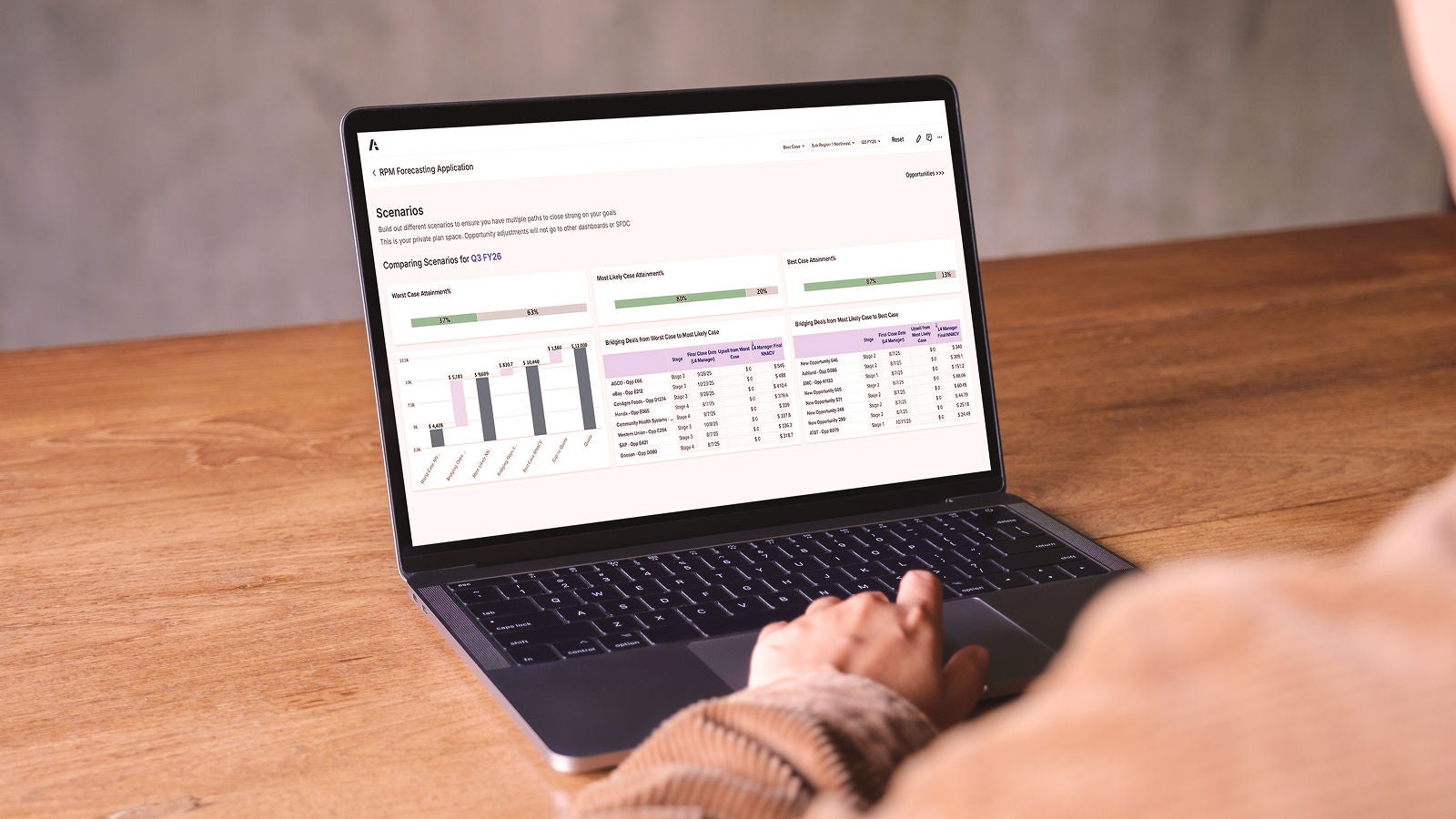
Scenario planning is critical for testing how pricing, promotions, and new product launches will impact your baseline. Traditionally, teams try to model these internal GTM changes using fragile, manual spreadsheets to guess at how different variables will play out.
The new way relies on dynamic simulations. When looking for a forecasting vendor, prioritize platforms equipped with a native calculation engine. This technology empowers you to instantly ask questions like, "What if a major deal slips to next quarter?" or "What if we adjust sales capacity?" By easily modeling how these variables impact your pipeline and revenue targets, your leaders are equipped to pivot faster.
5. Connect to operational execution
Once the forecast is quantified, it must be put to work. This is where you translate the sales forecast into dynamic quota and territory adjustments so your sellers can act with confidence. Additionally, headcount decisions, incentive planning, and day-to-day resource allocation should all stay tightly connected to real-time demand signals. This way your organization is always primed and ready to capture the revenue that's forecasted.
Keys to success in sales forecasting
Improving the accuracy of your sales forecasts and the efficiency of the forecast methodology depends on multiple factors, including strong organizational coordination, automation, reliable data, and an analytics-based process. Ideally, sales forecasts should be:
- Collaborative: Leaders should synthesize input from a variety of sales roles, business units, and regions. Frontline sales teams can be of great value here, providing a perspective on the market you hadn’t considered before.
- Data-driven: Predictive analytics can reduce the impact of subjectivity, which is often more backward-looking than forward-looking. Using common data definitions and baselines will foster alignment and save time.
- Rolled out quickly: Faster, more accurate forecasting helps implement the right sales strategies before the market or business priorities shift again.
- Single-sourced with multiple views: Generating the forecast as a single source of data enables the ability to do rollup views by rep, region, channel, or product line. This holistic view into company performance helps align different business functions across the organization.
- Improved as conditions change: Investing in the real-time capability to course-correct or reforecast allows sales leaders to refine GTM plans. Committing to regular sales forecasting adjustments can help avoid expensive mistakes.
Companies that continually adapt their forecasts have a major competitive advantage. Instead of discovering gaps after the quarter closes, they can model scenarios, redirect resources, and influence performance while there's still time to change the outcome.
Top sales forecasting challenges
When a forecast projects the wrong numbers, it disrupts the entire revenue engine. This results in a deep erosion of trust that can be hard to recover from. In fact, Salesforce reports that only 35% of sales professionals fully trust the accuracy of their organization’s data.
Here are some of the top sales forecasting challenges to avoid:
Accuracy and mistrust
When companies use spreadsheets for sales forecasting, data sources can easily fall out of sync with the latest version of a spreadsheet model. This leads to problems with accuracy, which in turn creates a less trustworthy forecast.
Subjectivity
Although producing a quality sales forecast will always require some level of human insight, too many organizations today rely heavily on subjective judgment rather than an objective assessment of the data. When reps and managers "go with their gut," it introduces bias that compromises forecast accuracy. To solve this, look for modern forecasting tools that help you strip away the guesswork.
Usability
When a sales forecast is locked inside siloed, manual spreadsheets, it is incredibly difficult for stakeholders across the company to use. To solve this, many organizations turn to basic dashboards built on top of their CRM, but while these are more visually "usable," they still fail to capture the full picture. A truly usable forecast must go beyond static numbers to easily model the critical nuance behind "best, worst, and most likely" scenarios. Look for forecasting tools that translate complex data into clear, interactive scenarios that multiple teams can easily digest, trust, and immediately act upon.
Inefficiency
Sales forecasts can be especially difficult to produce when inefficiencies are built into the forecasting process. For example, when a forecast has multiple owners, or the forecast process is not clearly spelled out with a standard set of rules, there can be disputes about how the forecast will be produced.
Are your sales forecasting calls counterproductive? Learn how to take control of planning discussions and feel more confident in your GTM planning.
Sales forecasting across the enterprise
Sales forecasting sits at the intersection of your entire business. Instead of each function interpreting data independently, a shared forecast acts as a coordinating mechanism. Here’s what different functions can benefit from the sales forecast:
- Sales: Gains a real-time, bottom-up view with data from your CRM and other sales tools. Sales can reallocate coaching and resources to the reps and deals that need them most based on how the forecast changes, maximizing quota attainment.
- Finance: Gains macroeconomic insight and works with the product teams. By integrating the sales forecast with their financial planning software, finance can adjust budgets, operating expenses, and sales capacity with confidence as pipeline conditions change.
- Marketing: Gains insight into pipeline health, allowing them to adjust campaign spending and demand generation efforts across marketing teams.
- Supply chain: Gains vital visibility with a real-time forecast into supply chain demand shifts to prevent excess inventory or costly stockouts.
- HR and workforce: Gains ability to accurately adjust sales capacity, ramp time, and recruiting efforts by performing strategic workforce planning with the sales forecast.
Rethink how you approach sales forecasting. This guide explores how you can evolve your sales forecasts into a tool for true revenue growth — one that improves alignment across finance, HR, and leadership.
Features to look for in sales forecasting software
Best-in-class sales forecasting software should be able to immediately improve the accuracy of your forecasts and make the forecasting process more efficient.
| Essential features | Business value |
|---|---|
|
Multi-dimensional sales forecasting |
Slice and dice pipeline data by product lines, geographic territories, account segments, or sales rep hierarchies. |
|
Analyze real-time trends and seasonality |
Develop time-based dashboards and key performance indicators (KPIs), such as velocity calculations, trending analytics, and seasonality fluctuations. |
|
Dynamic “what-if” scenario planning |
Run real-time simulations by adjusting key pipeline drivers, competitor behaviors, or economic variables. |
|
User-friendly calculation engine |
Build and customize complex forecasting formulas using a native, intuitive formula builder. |
|
Cross-enterprise and tech stack integration |
Unify data from CRM (like Salesforce), ERP, finance, HR, and supply chain systems into a single platform. |
|
Interactive dashboards and trend analytics |
Visualize historical runs, sales velocity, seasonality, and real-time performance KPIs on dynamic dashboards. |
|
AI-driven insights and predictive forecasting |
Uncover revenue blind spots with AI-surfaced recommendations to analyze pipeline health, buyer behaviors, and external market signals. |
“We get a lot of value out of our revenue reporting, and sales and operations planning reporting, and our financial reporting, all because those things are all connected in Anaplan. It allows us to make better decisions, allows us to reduce our excess and obsolete inventory, allows us to have more sales opportunities because we have the right product at the right place.” — VP Corporate Planning, Daikin Comfort Technologies
The role of AI in sales forecasting
AI moves forecasting beyond human intuition by processing a massive volume and variety of signals that are impossible to track manually. By continuously analyzing patterns across CRM data, seller activity, deal interactions, and third-party data, AI adds a layer of objective intelligence to the entire revenue process.
AI empowers your GTM team to:
- Uncover hidden trends: Identify patterns that a sales manager might miss, such as current impact of sand-bagging based on historical performance. Similarly, AI will detect the root causes of changes to deal progression based on rep behavior and market trends for a particular segment.
- Boost pipeline quality: See predictive signals that show you greenfield opportunities and provide early warnings for at-risk deals.
- Establish a trusted baseline: Take emotion out of the forecast and generate a transparent, explainable number that promotes transparency and alignment across finance, sales, and leadership.
- Pivot faster: Easily and quickly adapt your forecast for GTM teams to keep your revenue goals on track.
The right AI solution automates complex analysis, which frees your sellers to focus on what they do best: building relationships, thinking strategically, and closing deals with confidence.
Why use Anaplan for sales forecasting?
Anaplan is uniquely configured to improve sales forecasting. By putting all relevant employees — sellers, GTM leaders, operations, finance, supply chain, marketing, and leadership — on the same platform, companies can do the following:
- Increase seller accountability and improve sales pipeline accuracy: Identify sales deals at risk, eliminate “sandbaggers,” and reduce overcommits.
- Standardize sales forecasting and pipeline management: Provide a single line of sight across the entire organization so everyone has a view into revenue projections, sales projections, and operational insight.
- Improve trust in your GTM plan: Enable functional leaders to make better and more informed decisions by providing accurate and trusted sales forecasting to all business units.
- Access data-driven sales benchmarking and trend analysis: Enable sales leaders to use historical and current sales performance as a benchmark to predict future sales results.
With AI-driven sales forecasting that’s connected across the enterprise, companies can produce accurate revenue predictions and navigate market changes with confidence.